
I’m a long time admirer of Margaret Atwood and her work, but I’m not as familiar with her early poetry, which I’ve only recently begun to delve into. Atwood the author behind The Handmaid’s Tale, which was initially thought to be a dystopian novel but is actually a prophetic look into future of the U.S.
I found this rather psychically jarring poetic snippet in my wanderings through the internet, from a poem called November* that Atwood published in the 1970s:
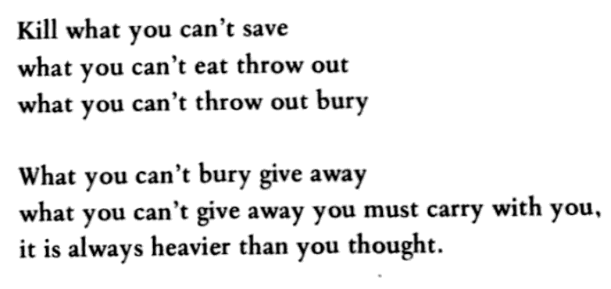
To me, this reads a bit like a prayer – the type of thing you repeat as a reminder that burdens are inevitable. The kind of thing you remind yourself of when things get hard, or maybe when things aren’t hard enough and you know that those hard times are coming.
And there’s a hierarchy to these things, though this hierarchy is a bit odd. A bit disordered. What you can’t bury give away – that seems like a strange sequence. To give away what can’t be saved, eaten, or buried – seems a bit macabre. What a terrible gift or trade for recipient. And then to carry it – a carcass may be heavy. The reminder is likely heavier.
The structure is similarly fascinating. The first line leads with a verb – a command, perhaps? Kill what you can’t save. Doesn’t that sound a bit biblical? A bit witchy? Is it mercy? It precludes the idea that perhaps it can save itself, or perhaps something else can save it. Is this power? Is this God?
And then we get four lines that begin with the same relative pronoun – a pronoun that, phrased differently, could be interrogative. But that’s not what’s happening here. It’s a restrictive relative clause, and that’s where the prayer-like quality begins, with its strange hierarchy, but the world is full of strange hierarchies.
Finally the lesson: What you carry with you is always heavier than you think. This is poetic, but also psychological – we all carry things that weigh us down. We all carry things we can’t put down. Or won’t. Or maybe don’t realize that we can.
Are the things we carry things we couldn’t save? Is this circular? We must carry it until we can kill it? Or are we the things we kill, is this some sort of obliteration? Is it an echo of the gospel, carrying our cross, being sacrificed upon the things we carry? It is a warning, to throw off as much of your kill as you can, by consumption, by discarding, by burying/hiding, by passing it along? Is this accountability, or blame?
Kill what you can’t save. But don’t kill wastefully. Don’t kill without taking on the burden of consumption, of discarding, of finding a place for your kill, or else you take it with you. What you can’t save never leaves you.
____________________________________________
*You can read the entire poem here on Google Books, from Margaret Atwood Selected Poems: 1965-1975.
November was originally published in a poetry collection called You Are Happy in 1974.

 Notes in the Margins