
I saw this movie back in 2008 in the theater, and really liked, but I haven’t seen the whole thing start to finish since then. This morning it happened to be on, and I sat and watched it and was amazed all over again. It’s actually quite good, and it’s a great movie for a writer to study.
You can watch the movie here, if you don’t have or can’t afford a streaming service. It was originally a play, and you can read the script here.
This story is ostensibly about a man and a boy, but it’s told via the perspective of various women – so it’s actually, in many ways, a story about women navigating patriarchal systems. It has some the big themes. Doubt. Sexual abuse in the Catholic church. Tensions between rigid gender roles. Questions of whether the end justifies the means. Evidence versus emotion. Innocence versus experience.
What I enjoyed in this rewatching was the tension. The push and pull between Sister Aloysius, principal of the elementary school, and Father Flynn, a teacher and coach at the school. Sister Aloysius suspects Father Flynn of having an inappropriate relationship with Donald Muller, the only African American student at the school. She confronts him, and he has a very believable explanation.
There’s a brilliant scene between Sister Aloysius and Mrs. Muller (the boy’s mother) in which she reveals some very difficult truths about Donald, and her husband, and what she, as a mother, is trying to do for him. At one point, she implies that she’s not inclined to ask questions or worry too much about an inappropriate relationship between Father Flynn and her son. Her point is, if this man is being good to my son, who am I to question why? He needs a man in his life who is good to him. Sister Aloysius replies, “What kind of a mother are you?”
She’s a mother in a very difficult situation, with a violent husband and a gay son, who has limited options and is doing her best. Her goal is to get Donald to college. Likely she sees it as a means of escape for him, and may feel that the ends justify the means. She has the in common with Sister Aloysius, even if neither of them can see it.
The final showdown between Sister Aloysius and Father Flynn begins at 1:18:55 when he confronts her in her office. At this point, Father Flynn knows that Sister Aloysius has talked to Mrs. Muller and realizes that she’s not going to stop pursuing the matter. First he tries aggression, which doesn’t scare her, then tries to appeal to her emotions, which also doesn’t work. At one point, Sister Aloysius yells back and Father Flynn, brandishing her crucifix like a knife, threatening to step outside the church, promising to “do what needs to be done” and consequences be damned.
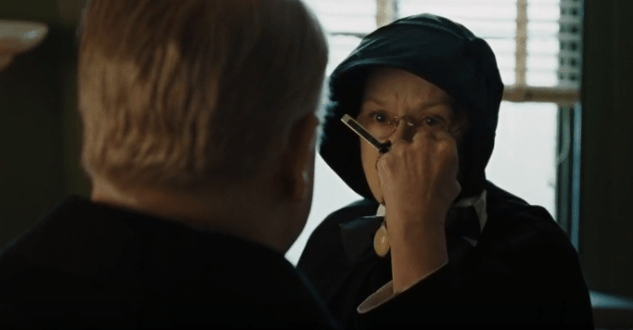
Goddamn.
Not too long after this, at 1:28:36 in the link above, is a moment I think sums up everything between them. Father Flynn vacillates between shows of aggression and appeals to emotion – that sort of oscillation is, by the way, a hallmark of an abusive personality.
Father Flynn: “I can fight you.”
Sister Aloysius: “You will lose.”
Father Flynn: “Where’s your compassion?”
Sister Aloysius: “Nowhere you can get at it.”
Streep delivering that line – Nowhere you can get at it – is one of my favorite moments in this film. It’s also just a good sequence of dialogue – quick, staccato, but packs a hell of a punch and was a good palate cleanser to follow the emotionally-charged, crucifix-as-a-weapon sequence.
Did Father Flynn do it? He’s also constantly put on the defense by Sister Aloysius about a very serious accusation, and most people in that position likely aren’t going to be their best selves. It’s the 1960s – an accusation of homosexuality, let alone with a Black minor, would ruin him, whether it’s true or not. He has reason to fear her.
The final time that Sister Aloysius asks Father Flynn if he gave the boy wine, Father Flynn says no – while nodding his head. What an amazing detail.
Is Father Flynn lying? That sort of mismatch is a possible sign of deception. But it could also be the sign of an internal conflict of some sort. It’s a small detail, but an important one.
Details are essential to good writing, and this is a movie loaded with details. We never know exactly what goes on between Father Flynn and Donald Muller. What we’re given are glimpses and small moments and from that, we the audience have to decide whose side we’re on. It’s a really good example of show don’t tell, because the film only gives you hints.
And what’s great is that the details you get in this film could be explained in multiple ways. Did Donald have alcohol on his breath because he stole altar wine? It’s plausible that a kid being abused at home and bullied at school would act out like that. Or did a predatory priest use wine to make Donald more pliable?
Meryl Streep and Viola Davis won awards for this film – and deservedly so. The scene they have together is brilliant. Davis is so good, in fact, that I forgot how small her role was – she’s not in most of the film, but she’s got the most memorable and powerful scene.
This film is a great study in details, in framing (the story seems to be about men/boys but is very much about women), and in building up tension and suspicion using carefully placed details that are often separated from their larger context, making their meaning ambiguous.
This is good writing.

 Notes in the Margins