
Writers can learn a lot by reading. This novella is a great study in plot and character arcs, pacing, feminine horror, representing less represented queer identities, and toxic relationship dynamics.
Overview
Bloom by Delilah Dawson is the story of Ro, a very new assistant professor of literature, and her obsessive relationship with Ash, an artisan whose products and home look like a perfectly curated social media aesthetic. As she gets deeper into a whirlwind relationship with Ash, she wakes up to her own bisexuality and gets so lost in her awakening that she sees, but ignores, signs that there is something sinister under Ash’s seemingly effortless aesthetic. Ash is incredibly private, and behind her talk of boundaries, the reader quickly gets a sense that she’s got secrets that she’s trying to protect. As the story progresses, Ash drops hints about what this secret may be, though Ro doesn’t begin to pull the threads together until it’s (nearly) too late.
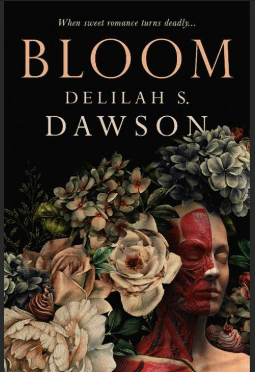
This novella was at least in part inspired by the tv show Hannibal. I have an alternate post on tumblr for the Hannibal crowd. I’m not going to get into the Hannibal tie-ins in this version of the review, but wanted to acknowledge them.
Review
The core of this story is beautiful veneers that hide something toxic. Ro and Ash themselves are attractive women with toxic traits. Ro has insecurities about her body, an inability to respect clearly stated boundaries, and uses weak mental gymnastics to justify her missteps. Ash is obsessively private, quietly controlling, and also disregards clearly stated preferences, ignoring Ro’s preferred name and pushing her to try things that she doesn’t like.
In some instances, Ash’s challenges to Ro open her up in ways that she seems to gladly give in to, but there are moments where Ro clearly doesn’t like her own boundaries being pushed. Ash, for her part, backs off a bit faster from Ro’s boundaries than Ro does with Ash’s, which results in a situation that gives a nod to a notable legend which I won’t mention or I’ll give away the ending.
That said, the trajectory of this story becomes fairly obvious early on. I don’t necessarily think that detracts from a story, but when you read Bloom, you’re there for the journey, because you’ll have a pretty good idea of what Ash’s secret may be. Not-so-subtle hints are dropped a long the way – obvious to the reader, but less so to oblivious Ro, who chooses to focus on the beautiful, self-assured veneer that Ash projects. Even when Ash does things that Ro finds disconcerting, she does her best to dismiss it.
The big revelation is less of an actual revelation, and more of a moment at which Ro can no longer ignore all of the clues that the reader will have put already together. From there, it careens into a brutal, stomach-twisting ending that reveals the true depths of Ash’s depravity. It all happens very fast.
The pacing is a bit odd throughout. Most of the story is the unfurling of the relationship between the two, including arguments caused by Ro’s overstepping that Ash seems a bit too willing to forgive. It became variations on a theme after a while. What’s done well is that the reader has a sense of where the story is heading, and I believe this is intentional. It creates a growing sense of tension and dread as Ro continues to stumble further and further into an uncertain relationship with Ash. Both women are feeling the other out, hoping that they have found the partner they’re looking for, but for drastically different reasons.
Ro being prone to doing things that Ash has clearly asked her not to for the flimsiest of reasons feels like convenient plot device to put Ro where she’s not supposed to be. I think this is also tied to the shorter novella format – sometimes there’s simply not time to linger, or figure out a way for things to reveal themselves in more organic ways, so the author did this to keep the story moving. But for me, it felt clunky at times. There are other ways that the author could have had Ro see things she wasn’t supposed to, or become suspicious of Ash.
Perhaps my favorite thing about this book is that Ro is a burgeoning bisexual, and while this isn’t explicitly stated, Ash reads to me as asexual. She willingly engages in foreplay and sex with Ro, but doesn’t seem to be motivated by physical attraction or a need for sexual contact. Ash clearly has desires, but I personally didn’t feel that they were tied to physical attraction so much as peeling back Ro’s layers, and her own, to slowly reveal themselves to each other.
My greatest disappointment is that Dawson chose to write this as a novella. There’s a lot of richness in this story, and more depths that could have been explored. This is a story you want to savor, not consume quickly.
What writers can learn
Reading something shorter and looking at the ways that the writer presents information in order to move the story along, and whether or not you feel that is successfully achieved, will help you when drafting your own stories. I personally feel like this should have been a full-length novel rather than a novella. A lot of the issues I have with it are, in my opinion, because the story may have been too ambitious for its format.
Another good study with this novella is pacing. A lot of reviewers feel that it was uneven due to the slow burn of the relationship, with the most of the action happening right at the end. Some people didn’t mind this, some did, but many called it out, so it’s a good thing to think about as a writer reading this story. Could some increased tension toward the middle might have made plot feel more like an arc and less like a sudden frenzied ascent? Or was the frenzied ascent the point?
Sexuality is also represented here in interesting ways. Ro is grappling with some new feelings, the novelty of which seems to be fueling her obsession. Her bisexuality is stated and something she ruminates on. Ash’s sexuality is less clear and never explicitly stated. Her preference for women is, but that doesn’t mean she’s a lesbian. As an asexual myself, I quickly got the vibe that Ash’s attraction to Ro is not so much physical as romantic and emotionally needful – which is confirmed when Ash eventually states what it is she is looking for. I thought it was an interesting way to represent two more underrepresented parts of the queer spectrum, and shows that sometimes things don’t necessarily need to be explicit to be present.
The ending is just brutal – the kind of brutal that leaves you feeling queasy. Thus the story moves from fae-like Instagram aesthetics of the beginning to an ending that is firmly in horror territory. Why end the story there? Was the the appropriate place? How does the transition from the pastel veneer of the beginning to the stomach-churning ending operate? Play with the readers’ emotions? What does it reveal not just about Ash, but about Ro?
Other things for writers to explore with this story:
– Horror in feminine and domestic spaces
– The food and flavor imagery and symbolism
– How obsessive fixation may cause someone to not see obvious red flags
– How Ro contributes to the toxic dynamic in the relationship
– How Ash repeatedly tests Ro throughout the story
– At the point the story ends, has Ash gotten what she wants?
This is worth a read for a lot of reasons, but my favorite one is how the story utilizes feminine spaces in a way that doesn’t feel like parody of femininity. Femininity is not denigrated or seen as a weakness or something superficial – it’s an integral to the story, the setting, how the characters interact, and how the horrors that are simmering underneath are able to go unnoticed.

 Notes in the Margins